An ice maker is one of those refrigerator features you rarely think about until it suddenly stops working. Whether you need ice for cold drinks, family gatherings, or everyday convenience, discovering an empty ice bin can quickly become frustrating.
+1 (866)-310-2780
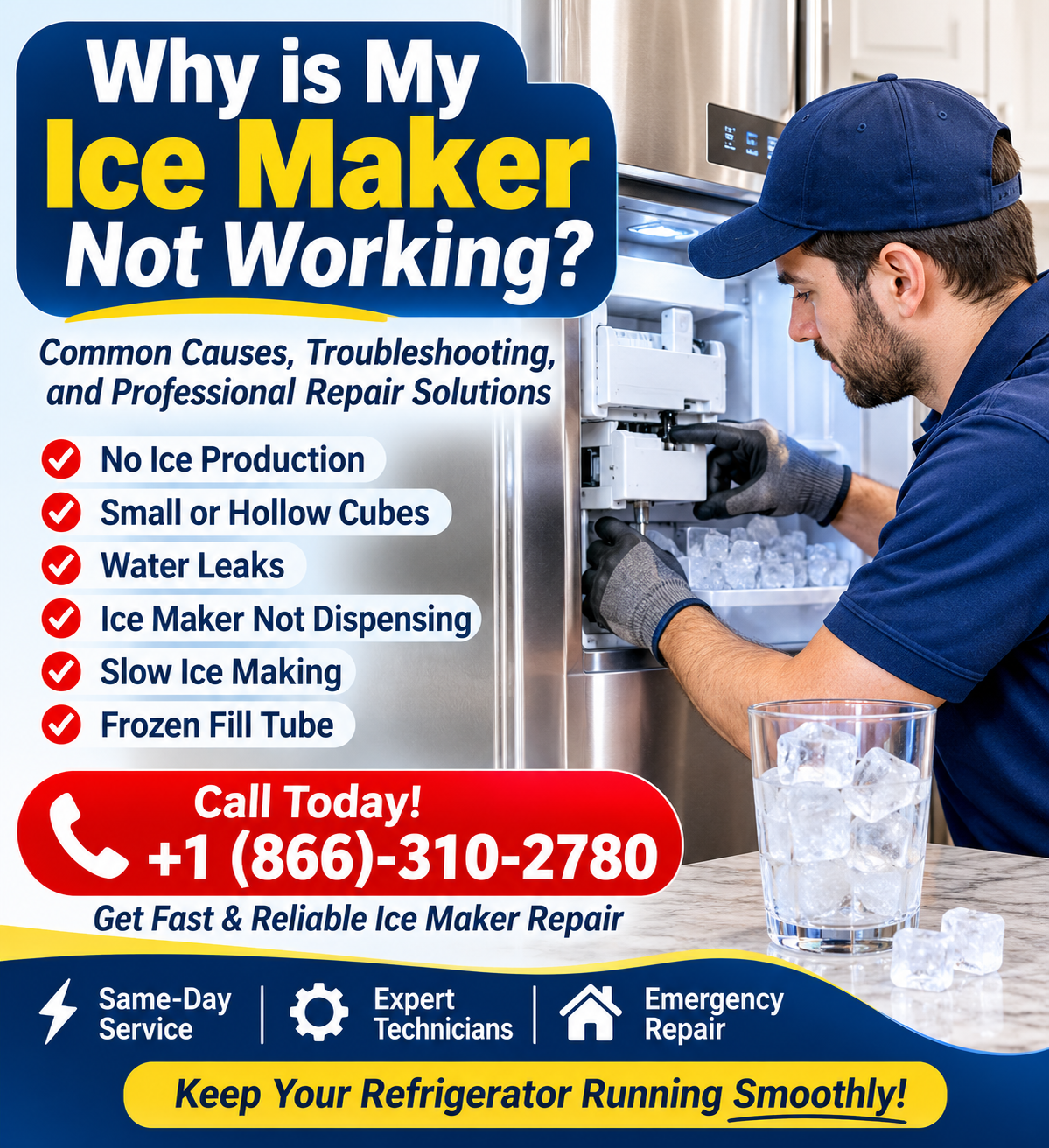
Why is my ice maker not working? Several issues can prevent your refrigerator from producing ice, including a clogged water filter, frozen water line, incorrect freezer temperature, faulty water inlet valve, defective ice maker motor, or electrical problems.
Sometimes, the problem is related to a simple setting or restricted water supply. However, persistent ice production problems may indicate a mechanical or electrical failure that requires professional attention.
Our experienced Home Appliance Repair technicians help homeowners identify refrigerator ice maker problems through careful inspections and advanced diagnostic techniques. If your ice maker has stopped producing ice, is leaking water, or is making unusual noises, contact our repair team at 📞 +1 (866)-310-2780 to ask about service availability.
Quick Overview: Why Is Your Ice Maker Not Working?
A refrigerator ice maker may stop working because of a restricted water supply, clogged filter, incorrect freezer temperature, frozen fill tube, malfunctioning water inlet valve, or damaged ice maker components.
Check whether the ice maker is switched on.
Make sure the refrigerator has an adequate water supply.
Check whether the water filter needs replacement.
Confirm that the freezer maintains the correct temperature.
Look for visible ice buildup or an improperly positioned ice bin.
If these basic checks do not solve the problem, professional refrigerator ice maker repair can identify the underlying fault and help prevent additional appliance damage.
Why Is My Ice Maker Not Working?
When a refrigerator ice maker stops producing ice, the problem usually involves the water supply, freezing conditions, or internal ice-making components.
An automatic ice maker follows a simple process. It receives water, freezes that water into cubes, and releases the finished ice into a storage bin. If one part of this process fails, ice production can stop.
Common reasons your ice maker stops working
Water supply problems: Water cannot reach the ice maker because of a restricted supply.
Clogged water filter: An old filter can reduce water flow and affect ice production.
Incorrect freezer temperature: A freezer that is not cold enough may prevent proper ice formation.
Frozen fill tube: Ice buildup can block the small tube that supplies water.
Faulty water inlet valve: A damaged valve may fail to deliver water when needed.
Defective ice maker assembly: Internal motors, sensors, or switches may stop functioning.
Ice bin problems: An incorrectly positioned or overfilled bin can interfere with ice production.
The correct solution depends on your refrigerator's brand, model, and specific symptoms. Manufacturer troubleshooting guidance also identifies water supply, freezer temperature, filter condition, and ice maker settings as common areas to investigate.
Whirlpool+2
Common Ice Maker Problems Homeowners Experience
Not every ice maker failure looks the same. Some refrigerators stop producing ice completely, while others make smaller cubes, produce ice slowly, or experience dispenser problems.
Understanding the symptoms can help homeowners recognize when professional refrigerator repair is necessary.
Ice maker not making any ice
Symptoms: The ice bin remains empty even though the refrigerator is running.
Possible causes: The ice maker is switched off, water is not reaching the unit, or an internal component has failed.
Repair solution: A technician checks the ice maker settings, water supply, electrical connections, and internal components to identify the problem.
Ice maker making ice slowly
Symptoms: The ice bin takes much longer than usual to fill.
Possible causes: A restricted water filter, frequent refrigerator door openings, poor freezer temperature, or reduced water pressure.
Repair solution: Professional inspection can identify water flow restrictions, temperature problems, and faulty components.
Ice maker not dispensing ice
Symptoms: Ice is available in the storage bin, but nothing comes out when you use the dispenser.
Possible causes: A jammed dispenser mechanism, faulty motor, damaged dispenser switch, or blocked ice chute.
Repair solution: A technician examines the dispenser assembly, motor, switches, and dispensing mechanism.
Ice maker leaking water
Symptoms: Water collects inside the freezer or beneath the refrigerator.
Possible causes: A damaged water line, leaking inlet valve, loose connection, or malfunctioning fill system.
Repair solution: The technician identifies the source of the leak and repairs or replaces the affected component.
Ice maker producing small or hollow cubes
Symptoms: Ice cubes are unusually small, incomplete, or hollow.
Possible causes: Restricted water flow, a clogged filter, or an issue with the water inlet system.
Repair solution: A professional checks the water supply and measures whether the system is delivering adequate water.
If you experience any of these problems repeatedly, arrange an inspection before the issue affects other refrigerator functions.
What Causes a Refrigerator Ice Maker to Stop Working?
Several technical problems can interrupt the ice-making cycle. Some involve water delivery, while others affect the refrigerator's cooling system or electrical controls.
Clogged or expired water filter
The refrigerator water filter removes unwanted particles from the water supply. Over time, accumulated material can restrict water flow.
Common warning signs include:
Ice production becomes noticeably slower.
Ice cubes become smaller than usual.
Water dispensing becomes slower.
Ice develops an unusual taste.
Solution: Replacing an overdue or clogged filter with the correct compatible model may restore normal water flow. Many manufacturers recommend replacing refrigerator filters approximately every six months, although the exact schedule depends on the model and water conditions.
Whirlpool+1
Faulty water inlet valve
The water inlet valve controls the amount of water entering the ice maker.
When this component becomes defective, it may fail to open correctly or may allow unwanted water to pass through.
Solution: A technician tests the valve and associated water supply components. If the valve is defective, replacing it with a compatible part may restore proper operation.
Freezer temperature problems
An ice maker needs sufficiently cold conditions to freeze water and complete its operating cycle.
If the freezer becomes too warm, ice production may slow down or stop.
Possible causes include:
Incorrect temperature settings.
Poor door sealing.
Blocked internal airflow.
Cooling system problems.
Frequent door openings.
Solution: A technician checks freezer performance, temperature regulation, airflow, and relevant cooling components.
Frozen water fill tube
The fill tube delivers water into the ice maker. If it becomes blocked by frozen water, the ice maker cannot receive the water needed to produce cubes.
Solution: Professional diagnosis helps determine whether the tube is frozen because of a water supply problem, incorrect temperature, or another underlying fault.
Damaged ice maker motor or control system
The motor and electronic controls coordinate the ice-making process.
When these components malfunction, the ice maker may stop filling, freezing, or releasing ice.
Solution: Technicians inspect the relevant electrical and mechanical components and replace defective parts when necessary.
Warning Signs Your Ice Maker Needs Professional Repair
An ice maker does not always stop working suddenly. In many situations, it shows warning signs before completely failing.
Recognizing these symptoms early can help prevent further problems.
Important signs to watch for
No ice production: The ice maker has stopped completing its normal cycle.
Unusual buzzing sounds: The water valve or another component may be struggling to operate.
Water leaking: Moisture around the refrigerator may indicate a damaged water connection.
Irregular ice cubes: Small, hollow, or misshapen cubes can indicate restricted water flow.
Repeated ice jams: Ice may be getting stuck inside the dispenser or storage mechanism.
Inconsistent performance: The ice maker works occasionally but repeatedly stops.
Freezer temperature changes: Cooling problems may affect the ice-making process.
Do not ignore recurring leaks, unusual electrical sounds, or cooling problems. If water is leaking near electrical components, avoid touching the affected area and have the appliance inspected safely.
For early assistance, call 📞 +1 (866)-310-2780 and ask about professional refrigerator repair availability.
How to Fix an Ice Maker That Is Not Working
The right repair depends on the underlying cause. While homeowners can perform a few basic visual checks, internal refrigerator repairs should be handled by qualified technicians.
Basic checks homeowners can perform
Before arranging a repair appointment, consider these non-invasive checks:
Check the ice maker setting: Make sure the ice maker has not accidentally been switched off.
Inspect the ice bin: Confirm that the storage bin is correctly positioned and not visibly overfilled.
Check the water filter: Review the manufacturer's replacement recommendations.
Look for visible water line damage: Check for obvious kinks or signs of leakage without moving or disconnecting the refrigerator.
Review the freezer temperature: Compare the current setting with the manufacturer's recommended setting.
Allow sufficient startup time: Newly installed refrigerators may need 24 to 48 hours before normal ice production begins, depending on the model.
Manufacturer guidance confirms that installation time, filter condition, water supply, and freezer temperature can all affect ice production.
LG USA Support+2
When professional ice maker repair is necessary
If the basic checks do not resolve the issue, a technician may need to:
Test the water inlet valve.
Inspect the ice maker assembly.
Diagnose faulty temperature sensors.
Examine electrical connections and control components.
Check for frozen or restricted water passages.
Evaluate the refrigerator's cooling performance.
Repair or replace defective components using compatible parts.
Avoid attempting electrical repairs, opening sealed refrigerator systems, or disconnecting internal water connections yourself. These tasks require appropriate training and equipment.
Emergency Ice Maker Repair and Same-Day Service
A malfunctioning ice maker can become more than a minor inconvenience, especially when it is accompanied by water leakage, unusual noises, or refrigerator cooling problems.
Emergency Home Appliance Repair services help homeowners address urgent appliance issues before they develop into more serious problems.
When should you request emergency appliance repair?
Consider requesting prompt professional assistance when:
Water is leaking continuously around the refrigerator.
The refrigerator or freezer is no longer cooling properly.
You notice unusual electrical smells or sounds.
The ice maker repeatedly causes water overflow.
The appliance has stopped functioning after an electrical problem.
If you notice an active water leak, shut off the accessible water supply only if it is safe to do so. Do not touch wet electrical components.
Benefits of same-day ice maker repair
Faster response: Early service can help reduce unnecessary appliance downtime.
Professional diagnostics: Technicians investigate the actual cause instead of relying on guesswork.
Convenient scheduling: Same-day appointments may be available depending on technician availability and location.
Reduced disruption: Prompt repairs can help restore everyday refrigerator convenience.
Preventive attention: Identifying related problems early may help prevent recurring breakdowns.
Need help with an urgent refrigerator issue? Call 📞 +1 (866)-310-2780 to discuss your symptoms and ask about emergency or same-day Home Appliance Repair service availability.
How to Maintain Your Refrigerator Ice Maker
Regular maintenance can help your ice maker operate more consistently and reduce the likelihood of certain preventable problems.
Practical ice maker maintenance tips
Replace water filters regularly: Follow the manufacturer's recommended replacement schedule.
Keep the freezer at the recommended temperature: Many household refrigerators use approximately 0°F (-18°C) as the standard freezer setting.
Keep the refrigerator doors closed properly: Frequent or prolonged openings can affect internal temperatures.
Clean accessible ice storage components: Follow the manufacturer's cleaning instructions for the ice bin and dispenser.
Avoid overfilling the ice bin: Keep the storage area clear so the ice maker can operate properly.
Check for visible leaks: Pay attention to moisture around the refrigerator and water connections.
Schedule professional inspections: Have recurring ice production problems investigated instead of repeatedly resetting the appliance.
Why preventive maintenance matters
Proper maintenance can help:
Maintain consistent ice production.
Reduce water flow restrictions.
Improve refrigerator performance.
Identify developing mechanical problems.
Extend the useful service life of appliance components.
A little preventive attention can help homeowners avoid unexpected refrigerator problems.
Benefits of Professional Refrigerator Ice Maker Repair
Although some ice maker problems involve simple settings or filter issues, internal failures require accurate diagnosis.
Professional repair helps identify the actual source of the malfunction and reduces unnecessary component replacement.
Why professional repair makes a difference
Accurate troubleshooting
Experienced technicians examine the water supply, electrical controls, temperature conditions, and mechanical components to locate the underlying problem.
Advanced diagnostic equipment
Professional diagnostic tools help identify problems that may not be visible during a basic inspection.
Compatible replacement components
Using appropriate replacement components helps maintain compatibility with the refrigerator's original design.
Reduced risk of additional damage
Incorrect repairs can create further problems involving water connections, electrical components, and cooling systems.
Convenience and time savings
Professional service allows homeowners to avoid spending time guessing which component has failed.
Whether your refrigerator has stopped making ice completely or is producing inconsistent cubes, professional diagnosis can help determine the most appropriate repair solution.
Why Choose Our Home Appliance Repair Service?
Choosing the right repair service matters when your refrigerator is not producing ice or experiencing other performance issues.
Our service focuses on practical solutions, professional diagnostics, and dependable customer support.
What homeowners can expect
Experienced technicians: Skilled professionals familiar with common refrigerator and ice maker problems.
Advanced diagnostics: Careful evaluation of water supply systems, electrical components, sensors, and mechanical assemblies.
Problem-focused repairs: Attention to the actual cause rather than unnecessary component replacement.
Customer-focused service: Clear explanations of the problem and recommended repair options.
Emergency repair assistance: Support for urgent appliance problems, subject to service availability.
Same-day appointments: Scheduling options when technicians and service appointments are available.
Preventive recommendations: Practical maintenance advice to help reduce recurring problems.
Our refrigerator ice maker repair services
We assist homeowners experiencing issues involving:
Refrigerator ice maker repair.
Ice maker not making ice.
Ice dispenser malfunction.
Water inlet valve problems.
Refrigerator water supply issues.
Ice maker motor and sensor problems.
Frozen fill tube concerns.
Refrigerator water leakage.
Inconsistent ice production.
Related refrigerator cooling problems.
If your ice maker has stopped working, contact our team at 📞 +1 (866)-310-2780 to explain the issue and ask about available repair appointments.
Service Areas Across the United States
Homeowners looking for professional refrigerator and ice maker repair can contact our team to discuss service availability in their location.
The following U.S. cities are examples of target service-area locations. Actual coverage and appointment availability should be confirmed before scheduling.
Houston, Texas
Dallas, Texas
Austin, Texas
San Antonio, Texas
Los Angeles, California
Phoenix, Arizona
Atlanta, Georgia
Chicago, Illinois
For service inquiries, call 📞 +1 (866)-310-2780 and confirm whether professional appliance repair is available in your area.
Frequently Asked Questions About Ice Makers Not Working
Why is my refrigerator ice maker not making ice but the water dispenser works?
If your water dispenser works but the ice maker does not, the problem may involve the ice maker assembly, frozen fill tube, water inlet valve, or internal control system. A working dispenser does not necessarily mean every part of the ice-making water system is functioning correctly. Professional diagnosis can identify the specific failure.
How do I reset my refrigerator ice maker?
Some refrigerator models include a dedicated reset button, while others use a control panel or power-cycle procedure. The correct method varies by manufacturer and model. Consult your refrigerator's owner's manual before attempting a reset. If the ice maker continues to malfunction afterward, an underlying mechanical, electrical, or water supply problem may require professional repair.
Why is my ice maker making small or hollow ice cubes?
Small or hollow ice cubes commonly indicate that insufficient water is reaching the ice maker. Possible causes include a clogged water filter, restricted water line, low water pressure, or a malfunctioning inlet valve. Replacing an overdue filter may help, but persistent problems should be checked by an appliance repair technician.
How long does it take for a refrigerator ice maker to start making ice?
A newly installed refrigerator or replacement ice maker may need approximately 24 to 48 hours to begin normal ice production, depending on the model and operating conditions. The freezer must first reach the required temperature. If your appliance still produces no ice after the manufacturer's recommended startup period, arrange a professional inspection.
Can a clogged water filter stop an ice maker from working?
Yes. A clogged or overdue refrigerator water filter can restrict water flow to the ice maker. This may result in smaller cubes, slower production, or no ice at all. Check the filter replacement schedule recommended by your refrigerator manufacturer. If replacing the filter does not restore production, the water supply system may need further inspection.
Why is my ice maker leaking water inside the freezer?
Water leaking inside the freezer may indicate a damaged water line, faulty inlet valve, improperly functioning fill system, or another internal problem. Frozen water around the ice maker can also affect its operation. Because leaks can damage nearby components and flooring, arrange professional refrigerator repair when the source cannot be identified safely.
Is it worth repairing a refrigerator ice maker?
In many cases, repairing an ice maker is a practical option, particularly when the refrigerator itself is operating properly. The best decision depends on the appliance's age, overall condition, failed components, and repair requirements. A qualified technician can inspect the unit and explain the available repair options before you decide.
When should I call a professional for refrigerator ice maker repair?
Contact a professional when your ice maker repeatedly stops working, produces irregular ice, leaks water, makes unusual noises, or fails to operate after basic checks. Problems involving internal motors, electrical controls, water valves, and cooling components require appropriate diagnostic equipment and repair experience. Call 📞 +1 (866)-310-2780 to ask about service availability.
Conclusion: Get Your Ice Maker Working Again With Professional Repair
An ice maker that stops working can disrupt your daily routine and make an otherwise reliable refrigerator less convenient. Fortunately, many ice maker problems can be identified and addressed through proper troubleshooting and professional repair.
Common causes include clogged water filters, restricted water supply, frozen fill tubes, incorrect freezer temperatures, defective inlet valves, and damaged internal components.
Recognizing the warning signs early can help prevent recurring problems and unnecessary appliance downtime. While basic visual checks may resolve minor issues, persistent malfunctions deserve attention from experienced appliance repair technicians.
Our Home Appliance Repair service focuses on accurate diagnostics, professional workmanship, and practical repair solutions for homeowners experiencing refrigerator and ice maker problems.
Do not let a malfunctioning ice maker become a bigger refrigerator problem.
Call 📞 +1 (866)-310-2780 today to discuss your ice maker issue, ask about emergency or same-day repair availability, and arrange professional Home Appliance Repair service in your area.